How it works
PriceTilt measures something different from what every other real-estate site measures. Here’s what we look at, where the data comes from, and what you get back.
What PriceTilt measures
Most real-estate tools answer one question: what is this property worth? That’s the Zestimate question — a valuation. Useful, but it doesn’t tell you anything about negotiation.
PriceTilt answers a different question: given this asking price, how flexible is the seller likely to be, and what does that mean for your starting offer? The Tilt Score is a 0-to-100 read on the seller’s position, not the property’s value. Higher means more leverage for you as the buyer. Lower means the asking price is well-supported by the data — you’ll get further negotiating on terms than on price.
What we look at
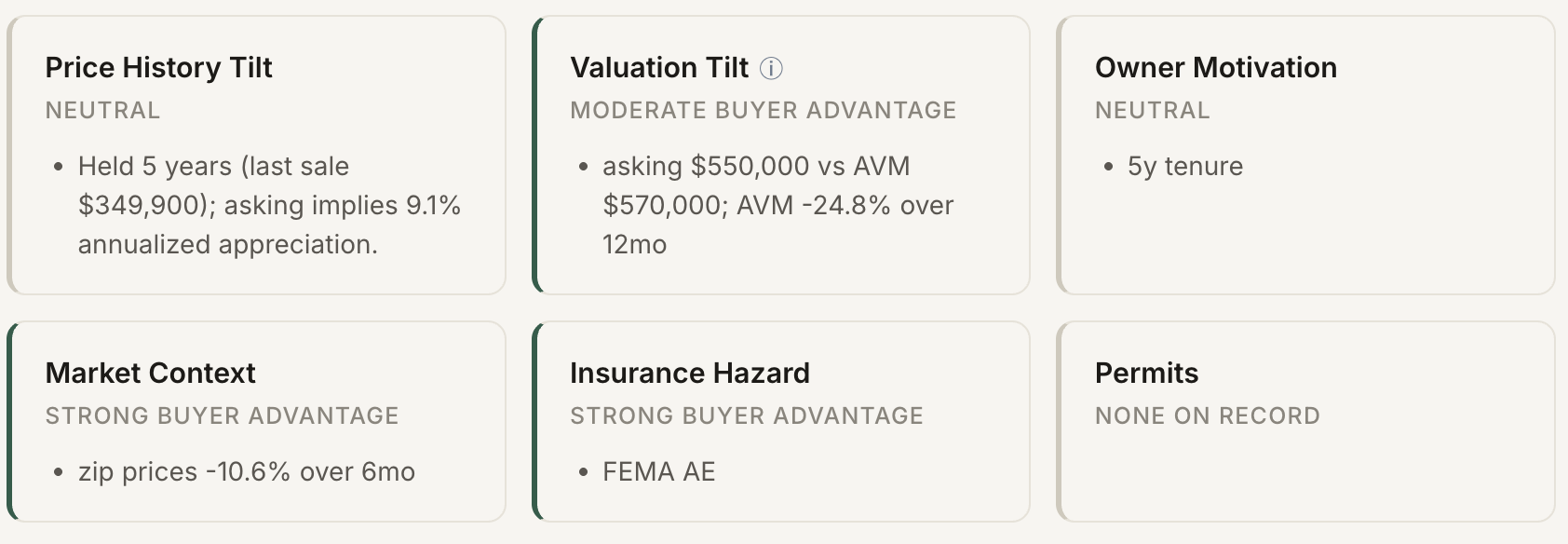
The Tilt Score is built from public-records and licensed-data signals organized into categories. We look at price history (what the seller paid, when, and how the property has appreciated), valuation context (how the asking price relates to independent valuations and their trend), owner motivation (tenure, ownership type, mailing-address patterns, equity position, distress signals), market context (neighborhood-level comp velocity and price direction), and hazard exposure (FEMA flood zones, transportation noise, climate risk — the costs the listing won’t quantify).
We don’t show the numeric weights or the formula — that’s the proprietary part of the methodology, the same posture Carfax and FICO take with their scores. We do show the inputs, the directional contribution of each category, and the specific public-records facts driving each direction.
Where the data comes from
Licensed and public sources only:
- ATTOM Data Solutions — deeds, sale history, tax assessments, owner records, automated valuation models, building permits, preforeclosure signals, and FEMA flood-zone designations. The same property-records backbone the listing side uses.
- Web search — for the free-tier chat, public web content, with an explicit blocklist of listing sites whose terms prohibit automated access.
- AWS Location Service — address standardization so we’re asking about the right parcel.
- Federal Reserve (FRED) — the current average mortgage rate for the PriceTilt Pro cost-to-own calculator.
Our data comes from licensed sources (ATTOM, AWS Location Service, FRED) and public records — accessed under terms that permit commercial use. Clean data sourcing matters to acquirers, and it matters to buyers.
The chat
Chat is the front door on both tiers. On the free tier, ask about any property and get answers grounded in its public records and licensed data; PriceTilt Pro adds unlimited chat with cross-session memory alongside the verified Tilt Score. Ask the things a listing page won’t — “is the flood zone a real concern here,” “what’s the owner’s equity position,” “how does this compare to recent neighborhood activity” — and get answers grounded in the actual records for that property.
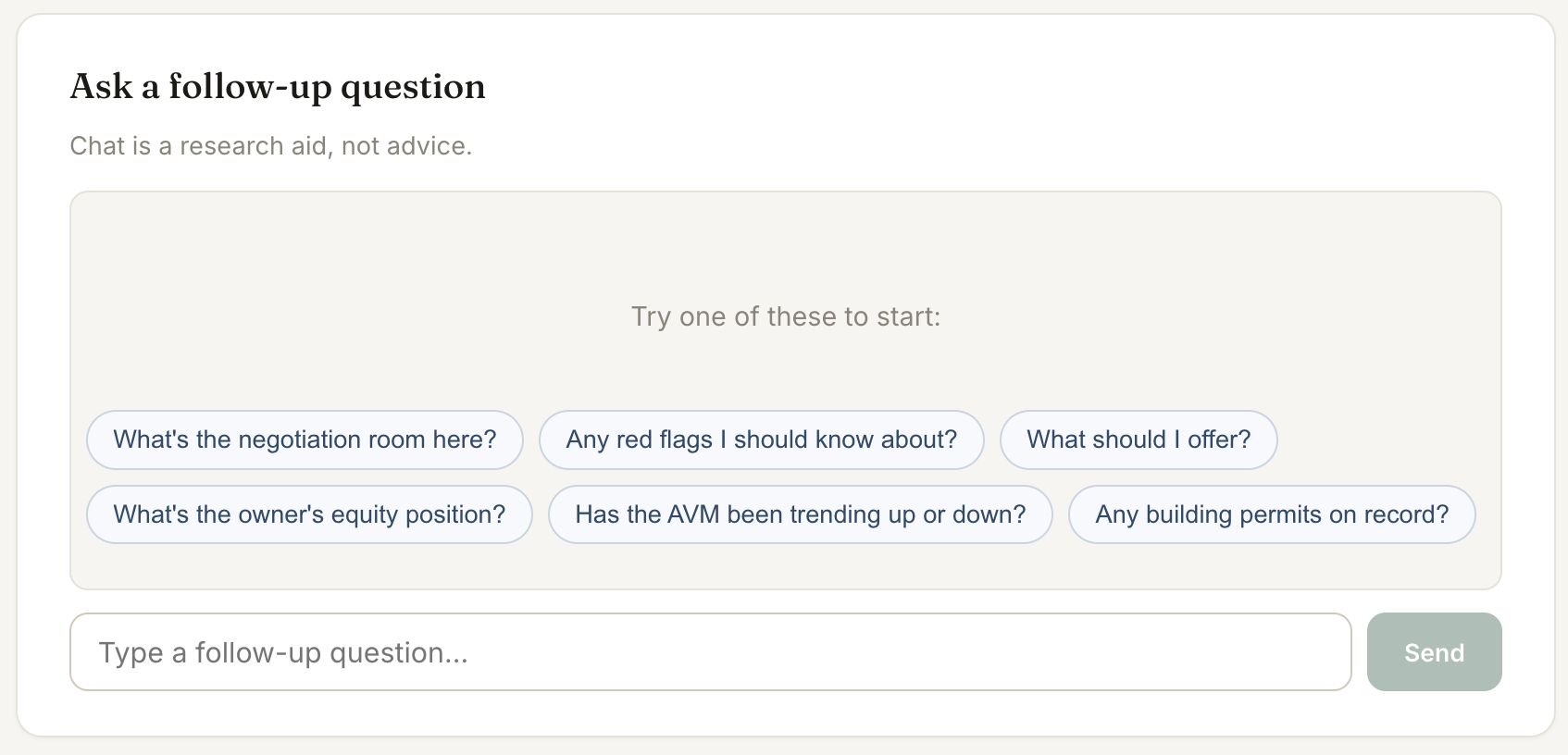
General-purpose AI assistants can’t answer property-specific questions because they don’t have the underlying records in their working context. PriceTilt does. That’s the part that turns the score from a one-shot number into a real research tool.
The chatbot will not disclose the methodology’s numeric weights or formula structure — that’s protected. It will explain directionally what’s driving your score, in plain English, with the underlying facts visible.
Versioning and methodology evolution
The methodology is documented and version-controlled. Every score is stamped with the methodology version that produced it. Past scores stay as scored — we don’t silently restate history when the methodology changes. Revisions get a version bump and a documented rationale.
This matters because PriceTilt is being built around a defensible IP asset. The audit trail is part of what makes it defensible.